
Residential Security & Key Control Guide
How Much to Rekey a House: 2026 Costs | Union Locksmith
Find out how much to rekey a house in 2026. Pin cylinder rekeying costs $15 to $50 per lock plus mobile dispatch across Pittsburgh and Western PA. Call 24/7.
- 24/7 Mobile Availability
- Greater Pittsburgh & Western PA
- Licensed & Insured Residential Locksmiths
Quick Summary: How Much to Rekey a House: 2026 Costs | Union Locksmith
How Much to Rekey a House Verdict: Rekeying a house costs between $130 and $290 for an average home, combining a $50 to $90 mobile trip fee with $25 to $50 per cylinder.
Standing on the porch of a newly purchased Pittsburgh home with unmarked keys brings an immediate realization: previous occupants, contractors, and realtors might still hold working copies. Securing your perimeter does not require discarding functional hardware. Rekeying is the physical adjustment of internal pin tumblers to accept a fresh key combination while rendering former keys inoperable. Rekeying resets cylinder pins to an entirely new key pattern at a fraction of replacement expenses.
Union Locksmith Services operates mobile units across Allegheny, Washington, and Westmoreland counties. Master Locksmith Mo S. leads technicians carrying precision pin kits, micrometer gauges, and replacement cylinders for Schlage, Kwikset, Yale, and Baldwin locks, rekeying thousands of residential cylinders annually with upfront pricing. Homeowners seeking reliable residential locksmith services in Pittsburgh gain complete perimeter control within a single visit. For company background, explore our about our team page or contact our dispatch desk for direct estimates. Reviewed by Master Locksmith Mo S. for technical accuracy.
Quick Navigation: 2026 Residential Rekeying Guide
- How Much Does It Cost to Rekey a House in 2026?
- What Factors Influence the Total Cost to Rekey House Locks?
- How Does the Rekeying Process Work Step by Step?
- Rekeying vs. Replacing Locks: Which Option Is Cheaper and Safer?
- How Do Different Lock Brands and Keyways Affect Rekeying?
- How Do You Rekey Historic Mortise Locks in Older Pittsburgh Homes?
- What Are the Rekeying and Master Key Options for Residential Landlords?
- Can Homeowners Rekey House Locks DIY With a Store-Bought Rekey Kit?
- The Union Locksmith Residential Rekeying Cost and Cylinder Architecture Matrix (2026 Guide)
- 2026 Pittsburgh Residential Locksmith Hardware and Rekeying Price Tracker
- Frequently Asked Questions About Rekeying a House
How Much Does It Cost to Rekey a House in 2026?
Rekeying a house is the professional modification of internal pin tumbler cylinders to accept an entirely fresh key combination while rendering former keys inoperable. For an average Pittsburgh home with 4 exterior doors, total rekeying costs range from $150 to $250. This overall price combines a mobile trip fee of $50 to $90 with an on-site labor charge of $25 to $50 per lock cylinder. Rekeying is the most economical security solution for new homeowners, eliminating prior access without purchasing brand new locksets. If homeowners remove door lock hardware themselves and bring cylinders to a workshop bench, shop bench rekeying costs $15 to $35 per cylinder by eliminating mobile travel expenses. Standard residential locks include single-cylinder deadbolts, keyed entry knobs, and exterior handle levers. Rekeying multiple locks to operate on a single shared key is standard practice, delivering unified security across front, back, patio, and attached garage entryways across Western Pennsylvania.
What Is the Average Overall Cost Breakdown for Single-Family Homes?
Single-family homes are the standard residential property across Western Pennsylvania, typically featuring three to six exterior lock cylinders. A three-door home in Penn Hills averages $135 to $210 total, while a five-lock residence in Mount Lebanon averages $175 to $290. Rekeying costs scale linearly per lock cylinder, ensuring matching pin bitting across all entries.
How Does Lab Bench Rekeying Compare to Mobile Locksmith Dispatch Fees?
A mobile locksmith trip fee is the baseline service dispatch fee covering travel, tooling, and door assessment, averaging $50 to $90 across Western Pennsylvania. In contrast, shop bench rekeying is an in-shop service costing $15 to $35 per cylinder when homeowners extract hardware themselves.
How Much Does Rekeying Cost per Cylinder for Deadbolts, Levers, and Keypads?
Cylinder architecture is the primary technical variable dictating individual rekey labor rates. Standard deadbolts and entry levers cost $25 to $40 per cylinder for on-site pinning. Double-cylinder deadbolts cost $40 to $70, while electronic keypad cylinders run $25 to $45.
What Factors Influence the Total Cost to Rekey House Locks?
The total cost to rekey a house is determined by five primary mechanical and operational factors: cylinder quantity, hardware brand, key availability, door condition, and service scheduling. Rekeying six cylinders costs proportionally more than rekeying two door locks because each tumbler requires individual pin replacement. Hardware brand complexity is a major labor factor; standard Kwikset KW1 cylinders re-pin quickly, whereas high-tolerance Schlage C keyways and luxury Baldwin Estate locks demand specialized disassembly tools. Working key availability is another critical pricing variable; when keys are missing, technicians must pick or decode the cylinder before extraction, adding $15 to $30 per lock in non-destructive bypass labor. A mobile locksmith trip fee is the flat dispatch charge covering vehicle travel, diagnostic tooling, and door alignment assessment. After-hours emergency calls or holiday dispatch add $50 to $100 surcharges compared to standard daytime appointments scheduled during normal business hours.
How Does the Number of Exterior Cylinders Affect the Total Price?
Exterior lock cylinder counts are the primary cost multiplier on residential projects. Homeowners often count doors rather than active keyholes, overlooking paired deadbolts and entry knobs. Auditing all exterior locks ensures transparent pricing estimates.
How Do Lock Brand and Cylinder Complexity Impact Labor Costs?
Hardware brand engineering is a critical factor influencing pinning labor time and precision tool requirements. Standard Kwikset deadbolts are economical five-pin tumblers with wide tolerances. Schlage C keyways are the industry benchmark profile, utilizing strict .015-inch bitting increments and anti-pick spool pins.
Why Does Rekeying Without a Working Key Cost More?
Working key availability is an essential operational requirement for standard cylinder disassembly. When existing keys are missing, technicians must pick the lock open or decode depths with an optical Lishi tool, adding $15 to $30 per lock in non-destructive bypass labor.
When Do After-Hours Emergency Locksmith Surcharges Apply?
Service appointment timing is a significant pricing factor distinguishing scheduled maintenance from emergency locksmith dispatch. Daytime appointments scheduled during standard business hours carry normal $50 to $90 rates. Emergency after-hours calls range from $100 to $160 for mobile dispatch.
How Does the Rekeying Process Work Step by Step?
Lock rekeying is the physical procedure of replacing internal bottom pins inside a lock cylinder so that obsolete keys cannot open the mechanism. Pin tumbler cylinders are the standard locking mechanisms installed on residential entrance doors throughout North America. A certified professional locksmith removes the cylinder plug from its outer housing using a specialized plug follower tool that safely retains upper driver pins and springs inside the upper bible chambers. The technician dumps obsolete brass pins, measures the cut depths of the new key using a bitting gauge, and loads new color-coded bottom pins that align precisely with the rotating cylinder shear line. Technicians providing professional residential lock rekeying adhere to strict ALOA Security Professionals Association pin tolerance standards. The completed cylinder is lubricated with dry PTFE spray, reinstalled inside the door chassis, and tested under real-world deadbolt throw tension to ensure smooth rotation.
Step 1: How Do Locksmiths Disassemble Lock Housings and Extract Cylinders?
A pin tumbler cylinder is a precision brass locking assembly containing upper driver pins, lower key pins, and springs aligned within vertical chambers. Disassembly begins by removing interior mounting screws. For deadbolts, the technician slides the cylinder free from the housing. For levers, the locksmith depresses the retaining catch to extract the core.
Step 2: How Does a Plug Follower Tool Safely Trap Driver Pins?
A plug follower is a precision cylindrical brass tool engineered to trap upper driver pins inside the lock bible while extracting the rotating plug. Removing the C-clip ring and turning the key 45 degrees allows the follower to slide flush behind the plug, trapping top pins securely.
Step 3: How Are New Bottom Pins Measured and Loaded to Match a Key?
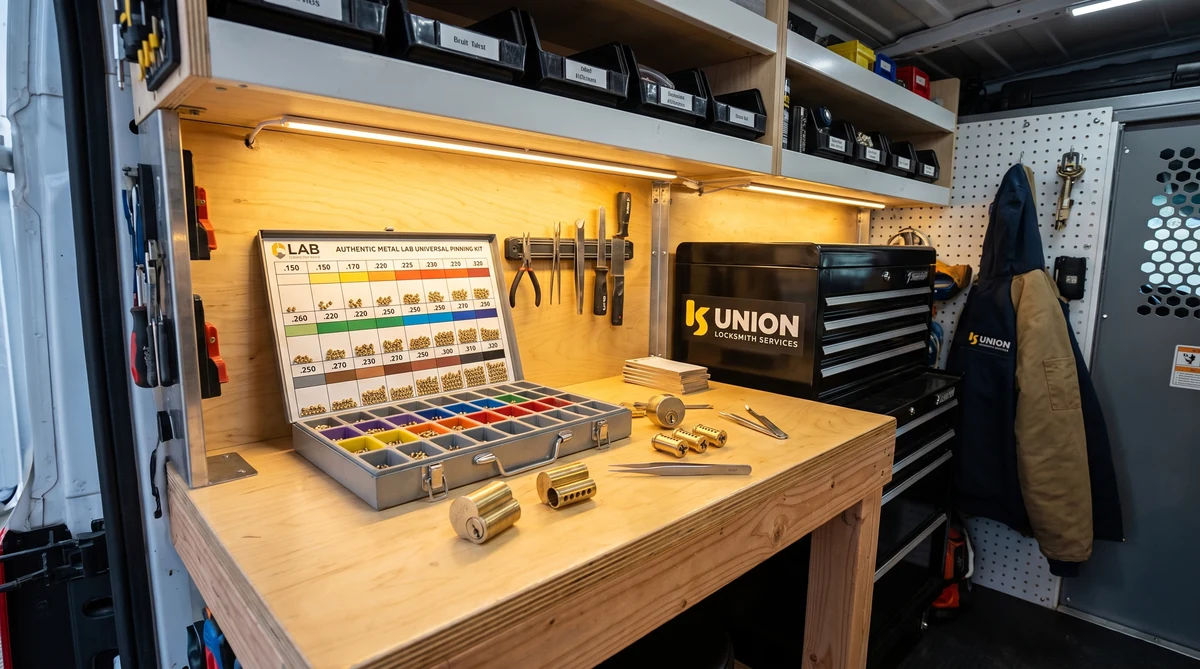
A key bitting gauge is a precision metal measuring tool used to determine the exact cut depths of a new factory key. The technician selects matching color-coded brass bottom pins from a LAB pinning kit, ensuring all pin tops sit flush with the plug surface.
Step 4: How Is the Cylinder Shear Line Tested and Lubricated?
The shear line is the mechanical alignment boundary between the rotating cylinder plug and the stationary outer cylinder shell. When the new key is inserted, bottom pins sit flush with the plug surface, creating an exact mechanical break. The technician tests rotation, applies PTFE lubricant, and checks throw alignment.
Rekeying vs. Replacing Locks: Which Option Is Cheaper and Safer?
Rekeying is significantly cheaper than lock replacement, saving homeowners 40% to 70% compared to purchasing new ANSI Grade 1 or 2 hardware (ALOA Security Benchmark, 2026). Rekeying is the process of altering internal pin tumblers while keeping existing handle sets, decorative escutcheons, and deadbolt housings intact. In contrast, full lock replacement is the complete removal of existing locksets and installation of brand new hardware. Replacing locks is only necessary when existing latches are physically worn, internal cams are broken, or homeowners desire an aesthetic upgrade to electronic keypad deadbolts or smart lock systems. Homeowners evaluating whether to re-pin functional hardware or invest in complete residential lock installation and deadbolt replacement must weigh structural integrity against replacement costs. Rekeying provides identical key revocation security as brand new hardware at a fraction of the expense, making rekeying the superior choice for move-in perimeter protection.
When Is Rekeying the Right Choice for Homeowners?
Rekeying is the preferred choice when existing locks operate smoothly and complement home architectural finishes. Homeowners moving into a new residence preserve matching handle sets by rekeying rather than spending hundreds on replacement. Rekeying instantly revokes prior keys while unifying all locks to one key.
When Is Full Lock Replacement Necessary Instead of Rekeying?
Full lock replacement is the complete removal of worn mechanical hardware and installation of brand new locksets. Replacing locks is necessary when internal gears stick or moisture corrodes cylinders beyond repair. Upgrading builder-grade locks to ANSI Grade 1 commercial deadbolts reinforces physical kick-in resistance.
How Does a 4-Lock Rekey Financially Compare to Full Lock Replacement?
Financial comparison reveals that rekeying four exterior locks costs approximately $215 total ($75 mobile trip fee + 4 cylinders at $35 each). In contrast, purchasing four new deadbolts and paying professional installation totals $340 to $620. Rekeying saves homeowners $125 to $405 while providing pristine perimeter key security.
How Do Different Lock Brands and Keyways Affect Rekeying?
Lock brand architecture is the mechanical determinant of cylinder keyway milling, pin spacing, and key interchangeability. Schlage C keyways are the industry benchmark profile for residential grade deadbolts, utilizing tight .015-inch bitting increments and spool anti-pick driver pins. Kwikset KW1 cylinders are standard five-pin tumblers with wider .023-inch tolerances, allowing rapid re-pinning with standard pinning trays. Locks from different manufacturers cannot accept the same physical key blank because incompatible milling grooves prevent cross-brand key insertion. When homeowners possess mixed hardware across different doors, a locksmith provides aftermarket conversion cylinders to establish single-key convenience. Furthermore, Kwikset SmartKey locks are specialized side-locking bar mechanisms that eliminate traditional top and bottom pins entirely. When homeowners evaluate whether to re-pin traditional mechanisms or transition to connected keyless deadbolts, our technical analysis comparing smart locks versus traditional deadbolts outlines the essential security differences.
What Makes the Schlage C Keyway the Standard for Residential Rekeying?
Schlage C keyways are the industry benchmark profile for residential grade deadbolts, renowned for exceptional mechanical reliability. Featuring strict .015-inch bitting increments, Schlage cylinders utilize spool driver pins that catch during picking attempts, creating an instant false set. Hardened front pins defend against drilling attacks.
How Do Kwikset KW1 Pin Tumblers Differ from Kwikset SmartKey Cylinders?
Standard Kwikset KW1 deadbolts are conventional five-pin tumblers with .023-inch bitting steps, enabling economical re-pinning. In contrast, Kwikset SmartKey cylinders eliminate brass pins, utilizing internal wafer sliders and a side-locking bar that require specialized reset cradles if jammed.
How Do Yale, Baldwin, and Corbin Russwin Residential Cylinders Differ?
Baldwin Estate, Yale, and Corbin Russwin cylinders feature specialized mechanical engineering requiring certified locksmith tooling. Yale cylinders employ tight paracentric keyways that restrict pick maneuverability, while Baldwin hardware pairs Schlage C keyways with heavy forged brass housings.
Can You Rekey Different Lock Brands to Use One Single Key?
Different lock brands cannot share a single physical key blank because unique keyway milling grooves prevent cross-brand key insertion. A Kwikset KW1 key blade will not enter a Schlage C cylinder keyway. To unify mismatched locks across front, side, and rear doors, locksmiths install universal aftermarket conversion cylinders, re-pinning all locks to share a single unified keyway profile.
How Do You Rekey Historic Mortise Locks in Older Pittsburgh Homes?
Cast-iron mortise locks are historical architectural assemblies standard in pre-war Pittsburgh construction across Squirrel Hill, Shadyside, and Lawrenceville. Rekeying historic mortise hardware is the delicate preservation process of servicing antique mechanical cassettes without boring modern cylindrical holes into irreplaceable vintage doors. Threaded mortise cylinders are specialized architectural lock components that thread directly into the heavy iron lock body and secure via an edge set screw. A professional locksmith unthreads the cylinder, replaces worn bottom tumblers with precision brass pins, and recalibrates the rear cam timing to guarantee smooth deadbolt throw. Antique bit-key mortise mechanisms are historic warded assemblies without removable pin cylinders, requiring custom skeleton key hand-filing or interior deadbolt conversion plates. Preserving vintage Pittsburgh woodwork through specialized cylinder servicing is the proven method to prevent destructive door modifications while maintaining authentic Craftsman and Victorian entryway aesthetics and long-term home security.
Why Is Preserving Vintage Mortise Hardware Crucial in Pittsburgh Homes?
Historic homes in Squirrel Hill, Shadyside, and the Mexican War Streets feature solid oak and chestnut entry doors. Boring modern 2-1/8-inch cross-bore holes permanently destroys historic value. Locksmiths extract vintage mortise cassettes, replace leaf springs, clean accumulated sludge, and restore silky operation while preserving original brass escutcheons.
What Is the Difference Between Threaded Mortise Cylinders and Antique Bit Key Locks?
Threaded mortise cylinders are modern 1-1/8-inch brass cylinders with external threading that screw into heavy mortise cassettes. The locksmith loosens the set screw, unthreads the cylinder, and re-pins the tumblers. Antique bit-key locks are older warded mechanisms operated by hollow-barrel skeleton keys requiring custom hand-filed blanks.
How Can High-Security Cylinders Be Retrofitted Into Vintage Mortise Locks?
Modern high-security cylinders can be threaded directly into antique cast-iron mortise cases, delivering advanced commercial-grade perimeter security. Homeowners can install Medeco or Schlage Primus cylinders into vintage lock bodies while preserving authentic 100-year-old exterior handles and decorative backplates intact.
What Are the Rekeying and Master Key Options for Residential Landlords?
A master key system is a tiered mechanical keying hierarchy that permits individual tenant keys to operate only designated apartment doors while a single master key opens all perimeter entrances and utility rooms. For duplexes and multi-family rental properties across Allegheny County, master key systems eliminate cumbersome key rings and enable rapid landlord access during heating or plumbing emergencies. Master split wafers are precision brass discs positioned above bottom pins to create dual shear lines within each pin chamber. Rekeying between tenant turnover is an essential legal standard under Pennsylvania rental practice; landlords who fail to rekey exterior entry locks between occupancies incur severe premises liability if prior unreturned keys facilitate unauthorized entry. Property owners managing multi-unit portfolios should review our operational guide on when to rekey commercial and rental locks and study Pennsylvania landlord tenant lock laws to maintain strict habitability compliance.
How Does a Master Key System Hierarchy Function for Residential Landlords?
A residential master key hierarchy engineered under Allegion Master Keying Standards organizes building access across two distinct operational tiers:
- Level 1 (Change Keys): Individual tenant keys operate only their designated private apartment front deadbolt and entry lever. Tenant A cannot open Tenant B’s door.
- Level 2 (Master Key): Property managers carry a single master key opening Apartment 1, Apartment 2, shared laundry facilities, and exterior common entryways.
This structure eliminates bulky key rings, accelerating routine maintenance visits and enabling rapid emergency entry.
What Are the Mandatory Tenant Turnover Rekeying Protocols Under PA Law?
Under Pennsylvania Uniform Construction Code (PA UCC) common law principles and municipal housing codes, residential landlords owe an affirmative duty of reasonable care to provide secure premises. Failing to rekey exterior entry locks between tenancies creates severe civil liability if unreturned keys lead to tenant harm.
How Do Master Wafers Prevent Cross-Keying in Multi-Family Systems?
Master split wafers are precision brass discs positioned above bottom pins to create dual shear lines within each pin chamber. Professional locksmiths utilize computer-generated bitting schedules with mandatory two-step depth differences to eliminate cross-keying and prevent tenant keys from opening neighboring units.
Can Homeowners Rekey House Locks DIY With a Store-Bought Rekey Kit?
DIY rekeying kits are retail blister-pack assortments purchased from home improvement centers for $15 to $35 to change pin tumbler combinations without hiring a locksmith. While DIY rekeying is technically possible for handy homeowners, the procedure carries substantial mechanical risks that frequently cause permanent cylinder failure. The primary risk of DIY rekeying is follower tool slippage; if the flimsy plastic follower tube separates even two millimeters from the rotating plug during extraction, upper driver pins and compressed springs violently collapse into the lower plug voids, permanently seizing the lock core. Extracting trapped driver pins requires specialized lock shims, dental picks, and professional locksmith tweezers. When factoring the $40 to $60 investment in kits and follower tools against the danger of ruining $80 deadbolts, hiring a professional locksmith provides certified pin tolerances, key duplications, and guaranteed operational security.
What Components Come Inside Home Improvement Store DIY Rekeying Kits?
Retail rekeying kits sold at Home Depot or Lowe’s typically cost $15 to $30. These packages contain three pre-cut brass keys, color-coded bottom pins matching the cuts, a stamped ring removal tool, and a thin plastic plug follower tube, engineered strictly for a single brand.
What Mechanical Risks Arise When Homeowners Attempt DIY Rekeying?
The primary hazard of DIY rekeying centers on plug follower slippage. If the plastic follower slips during extraction, upper driver pins and compressed springs violently drop into lower chamber voids, permanently seizing the lock core and often forcing replacement.
What Is the True Cost Difference Between DIY Rekey Kits and Professional Service?
DIY rekeying offers minimal financial benefit once true project costs are evaluated. Purchasing retail rekey kits and tweezers costs $40 to $60, accompanied by hours of delicate labor and zero warranty. In contrast, mobile service of $150 to $220 guarantees flawless operation.
The Union Locksmith Residential Rekeying Cost and Cylinder Architecture Matrix (2026 Guide)
The Union Locksmith residential matrix is an operational planning framework matching architectural door hardware to projected service costs. Evaluating property conditions against cylinder architecture allows homeowners to accurately predict project budgets before scheduling service. The matrix below outlines common residential rekeying scenarios across Western Pennsylvania:
[ORIGINAL DATA]
| Property Scenario | Typical Hardware Architecture | Recommended Locksmith Action | Average Cost Range | Security Rating |
|---|---|---|---|---|
| New Home Buyer Move-In | 3 to 5 doors with Schlage or Kwikset tubular deadbolts | Complete mobile rekeying of all cylinders to single key | $150 to $250 total | High: Eliminates prior owner access |
| Rental Property Turnover | 2 doors per unit on duplexes or single-family rentals | Rekey to tenant change key; integrate master key tree | $120 to $190 per unit | Medium-High: Balances privacy and access |
| Lost or Stolen House Keys | Intact deadbolts lacking existing working keys | On-site cylinder decoding/picking and complete repinning | $160 to $275 total | High: Completely revokes lost keys |
| Historic Pittsburgh Home | Vintage cast-iron mortise locks in Squirrel Hill/Shadyside | Disassemble mortise lock, service springs, rekey cylinder | $180 to $320 total | High: Preserves antique architectural wood |
| Mismatched Hardware Upgrades | Front door Schlage C; side and rear doors Kwikset KW1 | Rekey matching locks; swap mismatched conversion cores | $210 to $310 total | Maximum: True single-key convenience |
| Compromised Builder Hardware | Flimsy Grade 3 locks with loose latches or sticking bolts | Full replacement to ANSI Grade 1 high-security deadbolts | $320 to $550 total | Maximum: Maximum kick-in resistance |
How Can Homeowners Successfully Plan Their Residential Rekeying Project?
Planning an efficient residential rekeying appointment begins with a systematic perimeter door audit. Walk around your home and count every exterior lock opening, noting whether each door features a single deadbolt or both a deadbolt and a keyed handle. Inspect the face of the cylinder plug to locate manufacturer brand stamps such as Schlage, Kwikset, Yale, or Baldwin. Gather all existing keys that currently operate your doors to avoid lock picking surcharges during mobile service. Contact Union Locksmith Services to book a convenient mobile service window with our certified technicians.
2026 Pittsburgh Residential Locksmith Hardware and Rekeying Price Tracker
The 2026 Pittsburgh Locksmith Price Tracker is an empirical cost reference providing verifiable pricing benchmarks across Allegheny, Washington, and Westmoreland counties. Homeowners across Western Pennsylvania benefit from transparent, verifiable pricing benchmarks. The tracker table below outlines standardized rates for residential locksmith hardware and rekeying services across the Greater Pittsburgh metropolitan area:
[UNIQUE INSIGHT]
| Entity / Service Component | Category / Architecture | Operational Status | 2026 Pittsburgh & Western PA Cost | Primary Source Link | Last Verified |
|---|---|---|---|---|---|
| Mobile Trip Fee | Travel & Diagnostic | Active Mobile Dispatch | $50 to $90 flat rate | Union Locksmith Pricing | November 2026 |
| Standard Cylinder Rekey | Pin Tumbler (Kwikset/Schlage) | On-Site Mobile Service | $25 to $50 per cylinder | ALOA Locksmith Standards | November 2026 |
| Shop Bench Rekeying | Walk-In Cylinder Service | In-Shop Carry-In | $15 to $35 per cylinder | Union Locksmith Services | November 2026 |
| High-Security / Mortise Rekey | Commercial / Historic Grade | Specialized Precision Pinning | $40 to $75 per cylinder | Medeco Security Specifications | November 2026 |
| Master Key Configuration | 2-Tier Residential / Multi-Family | Custom Pin Bitting Schedule | $35 to $60 per cylinder | Allegion Master Key Systems | November 2026 |
| Kwikset SmartKey Reset | Side-Locking Bar Reset | Cylinder Recovery & Alignment | $35 to $65 per cylinder | Kwikset SmartKey Technology | November 2026 |
| Full Deadbolt Replacement | ANSI Grade 2 Hardware + Install | Complete Lockset Replacement | $110 to $220 per lock | Schlage Deadbolt Hardware | November 2026 |
How Does Mobile Locksmith Pricing Vary Across Allegheny, Washington, and Westmoreland Counties?
Locksmith pricing across Western Pennsylvania reflects regional travel distances and local housing architecture. In Allegheny County urban centers like Pittsburgh, Lawrenceville, and South Side, standard $50 to $80 mobile dispatch fees apply. Extended dispatch calls into northern Butler County or southern Washington County towns like Canonsburg and Peters Township carry travel fees between $65 and $90. Technicians from Union Locksmith Services provide transparent, flat-rate quotes upon arrival at your driveway. Our service vans carry complete inventories of replacement deadbolts, mortise parts, and brass cylinders, eliminating return visit charges.
Frequently Asked Questions About Rekeying a House
How much does a locksmith charge to rekey a 4-lock house in Pittsburgh?
Rekeying a four-lock house in Pittsburgh costs $150 to $250 total. This includes a $50 to $90 mobile trip fee, $25 to $40 per lock cylinder, four new keys, and complimentary latch lubrication and strike plate alignment.
Is it cheaper to rekey a lock or replace it entirely?
Rekeying is 40% to 70% cheaper (ALOA Survey, 2026) than replacement. Rekeying preserves existing handles and deadbolts, changing only the internal pin tumbler combination. Full replacement is only necessary when physical mechanisms are damaged.
Can all the locks in my house be rekeyed to one single key?
Yes, provided all locks share the same internal keyway profile, such as all Schlage C or all Kwikset KW1. For mismatched brands, locksmiths install universal aftermarket conversion cylinders so every door operates with one master key.
Can a locksmith rekey a lock without having the original working key?
Yes. If you lack the original key, a locksmith uses precision lock picks or decoding tools to rotate the cylinder plug before sliding the follower tool, adding a modest $15 to $30 surcharge per lock cylinder.
What is the difference between a Kwikset SmartKey cylinder and a standard pin tumbler lock?
Standard pin tumbler locks use vertical brass pin stacks lifted to a shear line by key bitting. Kwikset SmartKey cylinders eliminate pins, using internal wafer sliders and a side-locking bar that require specialized reset cradles if jammed.
Secure Your Commercial Facility in Greater Pittsburgh
Ensure NFPA 101 Life Safety code compliance, protect your facility from forced entry, and consult with Union Locksmith Services today. We provide 24/7 on-demand commercial dispatch, master key systems, and certified hardware across Allegheny and surrounding counties.