
Commercial Facility Security & Statutory Compliance Guide
Commercial Locksmith Services in Pittsburgh PA: The 2026 Facility Security and Compliance Guide
A comprehensive facility security and compliance guide covering panic hardware, Adams Rite storefront mortise locks, master key hierarchies, ANSI Grade 1 deadbolts, and Pittsburgh egress regulations.
- 24/7 Mobile Availability
- Greater Pittsburgh and surrounding areas, PA
- Licensed & Insured Commercial Technicians
Quick Summary: Commercial Facility Locksmith Services in Pittsburgh
A jammed storefront deadlatch on Penn Avenue or an unexpected egress notice from the City of Pittsburgh Department of Permits, Licenses, and Inspections halts commercial operations instantly. Commercial property managers cannot afford dispatch delays, dispatch fees, or non-compliant installations violating Pennsylvania Uniform Construction Code regulations.
Table of Contents
Whether you manage a busy storefront in Lawrenceville, an office suite Downtown, or an industrial facility in Monroeville, commercial door security centers on three essentials: life safety compliance, heavy-duty physical durability, and strict key control. At Union Locksmith Services, our mobile units handle these challenges daily across Allegheny, Westmoreland, and Washington counties, installing fire-rated panic hardware, repairing Adams Rite storefront deadlatches, and engineering tiered SFIC master key systems.
If you need immediate emergency hardware repair or are planning a comprehensive security overhaul, our certified technicians provide prompt on-site support through our commercial locksmith services in Pittsburgh with 24/7 mobile dispatch.
What Commercial Locksmith Services Are Essential for Pittsburgh Businesses?
Securing a commercial enterprise in Greater Pittsburgh and surrounding areas requires proactive mechanical maintenance, emergency rapid response, and strict life safety code compliance. Professional commercial locksmiths safeguard business continuity by combining non-destructive entry protocols, precision cylinder rekeying, and architectural hardware repairs under unified service standards. In the City of Pittsburgh, commercial facilities must maintain certified hardware meeting Pennsylvania Uniform Construction Code standards and Title 34 Pa. Code egress mandates. High-traffic storefronts and industrial complexes experience mechanical wear that causes sudden latch failures, misaligned pivots, or compromised deadlocks capable of triggering municipal violation notices during routine inspections. Mobile field units equipped with ANSI Grade 1 components and heavy-duty mortise cylinders resolve operational stoppages across Allegheny County within sixty minutes. Facility managers should immediately audit exterior perimeter doors and establish an on-demand commercial service agreement with a licensed local locksmith. Scheduling routine mechanical diagnostics before winter freeze-thaw cycles prevents costly emergency door replacements and keeps your retail or office entryways operating reliably.
24/7 Emergency Commercial Door Lockout and Damage-Free Entry
Technicians use rotary picks to unlock commercial mortise locks without drilling, avoiding replacement hardware charges during a lockout.
Commercial Rekeying and Master Key System Upgrades
We rekey cylinders after employee turnover without replacing locksets, configure master key systems for apartment properties, and re-pin file cabinet locks to secure sensitive records.
Related Guide: Read our complete facility security guide on when to rekey business locks for employee departure protocols, PA premises liability rules, and SFIC core swaps.
High-Security Hardware Installation and Door Closer Adjustments
We calibrate LCN 4040XP hydraulic closers to stop door slamming, and install commercial keyless digital keypad locks for audit-tracked access.
How Do Adams Rite Storefront Mortise Locks Protect Pittsburgh Retail Doors?
Adams Rite storefront mortise locks deliver the industry benchmark for securing narrow stile aluminum glass doors across Pittsburgh retail districts. Selecting between maximum security deadlocks and heavy-duty deadlatches determines whether a business achieves deadbolted physical perimeter defense or controlled access with electric strike compatibility. Adams Rite MS1850S is an ANSI/BHMA Grade 1 narrow stile mortise deadlock engineered with a laminated stainless steel bolt and alumina-ceramic core to resist physical prying and hacksaw attacks. Deadlatch mechanisms like the 4510 and 4900 series feature deadlocking auxiliary pins that must seat properly inside strike cutouts to stop credit-card shimming. Because Pittsburgh winter freezes contract aluminum extrusions, mortise cylinders require authentic Adams Rite 8600 cams to prevent internal binding. Retail property owners should verify backsets (31/32-inch, 1-1/8-inch, or 1-1/2-inch) before ordering hardware. Partner with an experienced technician to adjust bottom pivots, shim strikes, and ensure auxiliary pins deadlatch smoothly throughout severe freezes.
MS1850S Maximum Security Deadlocks vs. 4510 Heavy Duty Deadlatches
The Adams Rite MS1850S straight bolt resists pry bars, while the 4510 deadlatch latches automatically for electric strikes. See our storefront lock replacement and mortise deadbolts options.
Correct Backset Measurements: 31/32-Inch, 1-1/8-Inch, and 1-1/2-Inch Standards
Narrow stile doors use 31/32-inch (historic in Downtown and Squirrel Hill), 1-1/8-inch, or 1-1/2-inch backsets, stocked on mobile vans.
Mortise Cylinder Cam Selection: Adams Rite Cams vs. Standard Straight Cams
Straight cams bind in Adams Rite bodies, requiring an authentic Adams Rite 8600 cam to trip dogging arms properly.
Why Is ANSI/BHMA Grade 1 Hardware Mandatory for Commercial Security?
Installing certified commercial hardware is mandatory for properties seeking uncompromised perimeter defense, durability, and liability protection. Residential locks fail rapidly under the mechanical abuse of heavy commercial customer traffic and targeted forced-entry attempts. ANSI/BHMA Grade 1 is the highest commercial hardware performance certification standard, requiring auxiliary deadbolts to endure at least 250,000 operational cycles and 10 consecutive 75-foot-pound hammer strikes. Under ANSI/BHMA A156.13 benchmarks, commercial mortise locksets must complete 1,000,000 operational cycles while resisting 1,350 pounds of perpendicular door pressure without latch collapse. These certified commercial assemblies feature solid steel 1-inch throw bolts, hardened free-spinning internal pins to defeat hacksaw blades, and reinforced security strikes anchored by four 3-inch frame screws. Commercial property administrators should inspect high-traffic entry doors for substandard hardware. Upgrading vulnerable exterior entries to Grade 1 commercial deadbolts like the Schlage B660P prevents forced entry and guarantees uninterrupted compliance across Allegheny County facilities.
Operational Cycle Lifespans: Grade 1 (250,000+ Cycles) vs. Grade 2 (400,000 Cylindrical)
Grade 1 deadbolts endure 250,000 cycles, outlasting residential Grade 2 locks under commercial traffic. We recommend a Grade 1 upgrade to eliminate latch failure.
Physical Attack Resistance: Solid Steel Anti-Drill Pins and 10-Blow Hammer Tests
Schlage B660P deadbolts resist lock pick attacks, endure 10 hammer strikes at 75 foot-pounds under A156.36, and anchor with four 3-inch screws to stop kick-in attacks.
What Are the Key Differences Between Rim Panic Devices and Vertical Rod Exit Bars?
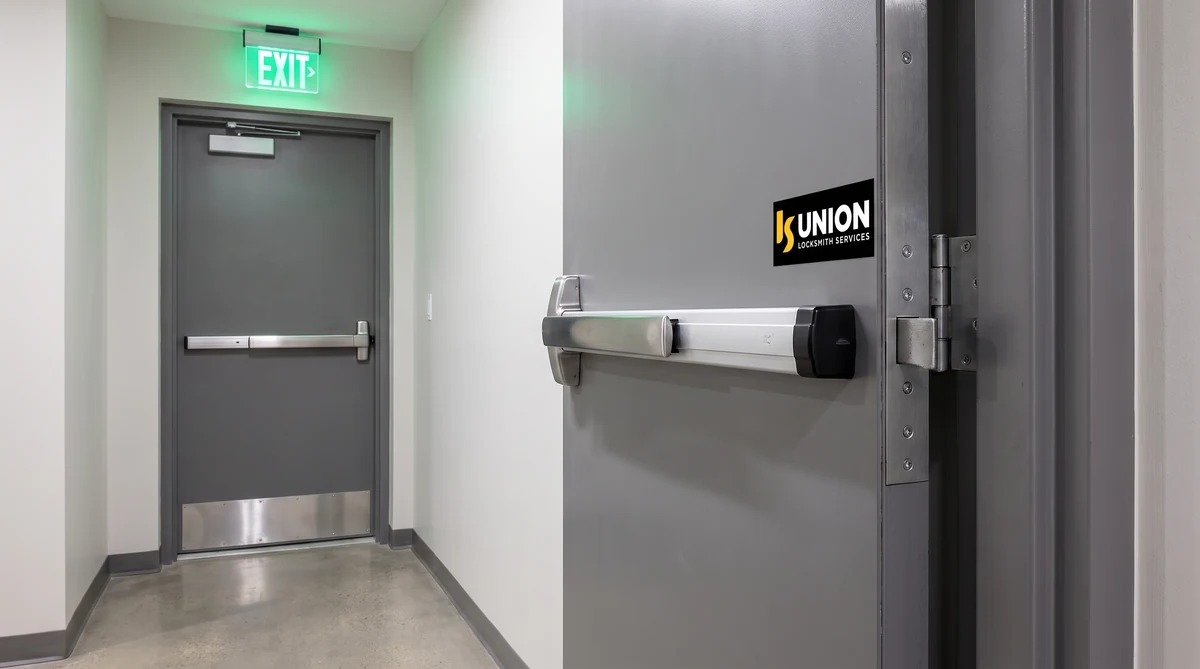
Selecting between rim panic devices and vertical rod exit systems depends directly on doorway construction, traffic volume, and environmental exposure. Single commercial doorways rely on surface rim exit devices latching into frame-mounted strikes, delivering maximum mechanical durability and minimal maintenance. Double commercial doors require either Surface Vertical Rods (SVR) or a pair of rim devices paired with a keyed removable mullion. Tested under ANSI/BHMA A156.3 Grade 1 benchmarks for 500,000 cycles, commercial panic hardware must release under 15 pounds of actuation force to satisfy life safety egress codes. in Greater Pittsburgh and surrounding areas area, winter road salt and slush regularly corrode floor strikes, causing bottom vertical rods to jam or drag against concrete thresholds. Crucially, NFPA 80 prohibits mechanical dogging on fire-rated doors because assemblies must positively latch during fires to contain smoke and heat. Commercial building administrators should audit exit corridors annually and convert problematic vertical rod systems to Less Bottom Rod (LBR) designs.
Single Commercial Doors: Rim Exit Devices and Frame Strikes
Rim panic devices house latches within the crash bar, securing into frame strikes without floor contact. Explore our commercial panic bars and exit devices options.
Double Door Pairs: Surface Vertical Rods (SVR) vs. Removable Center Mullions
Removable center mullions or Less Bottom Rod (LBR) devices eliminate floor strike corrosion from winter road salt while satisfying NFPA 80.
Fire-Rated Exit Doors: Why Mechanical Dogging Is Strictly Prohibited Under NFPA 80
NFPA 80 prohibits dogging on fire doors. For daytime push-pull fire access, we install electrified latch retraction (ELR) devices wired to fire alarms.
How Do Tiered Master Key Systems Function (SFIC vs. LFIC)?
Tiered commercial master key systems grant building owners rigorous access control while reducing key ring clutter across large facilities. By structuring keys into an organized mathematical hierarchy, administrators provide designated access permissions for executives, department managers, maintenance staff, and individual office workers. The hierarchy scales across five distinct tiers: Great Grand Master, Grand Master, Master, Sub-Master, and individual Change Keys. SFIC (Small Format Interchangeable Core) refers to a standardized modular cylinder architecture utilizing the Best A2 system with a specialized control key for rapid core extraction without disassembling the lock chassis. These cores feature uniform .0125-inch pin increments and a 23-depth stack calculation rule. Large Format Interchangeable Cores (LFIC) maintain brand-specific keyways like Schlage or Corbin Russwin but cannot swap across competing manufacturers. Proper mathematical matrix engineering prevents cross-keying and eliminates dangerous phantom keys that unlock unintended commercial doorways. Facility managers dealing with turnover should deploy SFIC systems to instantly rekey office doors without labor downtime.
The Five-Level Hierarchy: From Great Grand Master to Individual Change Keys
A five-tier hierarchy organizes access across Allegheny and Westmoreland County. Discover our commercial master key system design services.
Small Format Interchangeable Core (SFIC) vs. Large Format (LFIC) Comparison
SFIC Best A2 cores enable 3-second control key swaps to streamline rekeying setup, while LFIC cores retain proprietary Schlage profiles.
Preventing Cross-Keying Vulnerabilities and Phantom Keys
Random master pinning creates cross-keying and phantom keys. Locksmiths use bitting matrix software to observe MACS limits across every corporate institution.
What Pittsburgh Commercial Building Codes and NFPA 101 Egress Rules Apply?
Commercial locks and emergency exit hardware in Greater Pittsburgh and surrounding areas must satisfy the Pennsylvania Uniform Construction Code and NFPA 101 Life Safety Code. Local municipal enforcement by the City of Pittsburgh Department of Permits, Licenses, and Inspections (PLI) prioritizes unobstructed egress for all facility occupants. Under NFPA 101 Section 7.2.1, doors along required paths of travel mandate single-operation egress, unlatching with one intuitive motion without keys or special effort. IBC 1010.2.9 mandates panic hardware releasing under 15 pounds of actuation force for assembly spaces exceeding 50 occupants. In addition, ADA / ICC A117.1 accessibility regulations require operable mechanisms to release under 5 pounds of force while mounted 34 to 48 inches AFF. Property managers should audit existing doors to eliminate illegal double-cylinder deadbolts that endanger safety. Contact a licensed commercial locksmith immediately to perform a formal compliance survey and retrofit approved single-motion egress devices.
Single-Operation Egress Mandate: One Motion Without Keys or Special Effort
Inspectors enforce single-operation egress under NFPA 101 and IBC 1010.2. Exit doors must unlatch with one motion, so we replace non-compliant locks with interconnected locksets.
Occupancy Load Thresholds: When Panic Hardware Becomes Mandatory (>50 Occupants)
Under IBC 1010.2.9, panic hardware is mandatory on Assembly and Educational spaces serving 50 or more people across Strip District dining corridors.
Hardware Mounting Elevations (34 to 48 Inches AFF) and ADA 5-Pound Operating Force Limits
ADA rules require hardware mounting between 34 and 48 inches AFF, with levers operating under 5 pounds and panic bar assemblies releasing under 15 pounds.
The Union Locksmith Commercial Egress and Hardware Compliance Matrix (2026 Guide)
Commercial facility managers face strict compliance standards under Pennsylvania construction codes. Union Locksmith Services adheres to a four-stage compliance lifecycle matrix:
| Process Stage | Facility Owner Action | Locksmith Role (Union Locksmith) | Municipal Code Authority | Standard Benchmark |
|---|---|---|---|---|
| Stage 1: Discovery & Audit | Inventories hardware and sticking latches. | Audits swing, latching, backset, egress. | Mandates unhindered egress during business hours. | NFPA 101 Section 7.2.1 and IBC Chapter 10. |
| Stage 2: Specification & Engineering | Approves hardware specifications. | Engineers backset, Grade 1, SFIC charts. | Issues required alteration permits. | ANSI/BHMA A156.36 and A156.3. |
| Stage 3: Precision Installation | Coordinates scheduled deployment. | Preps stiles, 3-inch screws, tunes closers. | Inspects continuous egress unlatching. | ADA / ICC A117.1 (5 lbf max). |
| Stage 4: Lifecycle Verification | Maintains keys and quarterly tests. | Issues key logs and 24/7 service. | Enforces annual life safety sweeps. | NFPA 80 Fire Door Standards. |
Step-by-Step Implementation Protocol for Facilities
Executing this four-stage matrix shields facilities from regulatory penalties. Technicians inspect egress pathways, test panic hardware release forces below 15 pounds, and supply itemized specifications with zero surprise service fees.
2026 Pittsburgh Commercial Locksmith Hardware and Service Pricing Tracker
Transparent commercial pricing is essential for facility budgeting. In contrast to deceptive dispatch brokers who advertise as a cheap locksmith only to charge inflated dispatch fees, Union Locksmith Services delivers clear itemized pricing:
| Entity / Item | Category / Architecture | Current Status | Pricing / Key Metric | Primary Source Link | Last Verified |
|---|---|---|---|---|---|
| Adams Rite MS1850S Storefront Deadlock | Narrow Stile Mortise / Maximum Security | Active Commercial Standard | $145-$220 ($125-$195 labor) | Adams Rite Catalog | October 2026 |
| Schlage B660P Heavy Commercial Deadbolt | ANSI/BHMA A156.36 Grade 1 Auxiliary Deadbolt | Active Commercial Standard | $95-$160 ($85-$130 labor) | Schlage Hardware | October 2026 |
| Von Duprin 99 Series Rim Exit Device | ANSI/BHMA A156.3 Grade 1 Panic Exit Bar | Active Commercial Standard | $650-$980 ($220-$380 labor) | Von Duprin Catalog | October 2026 |
| Best Access 7-Pin SFIC Core (A2 System) | Small Format Interchangeable Core | Active Commercial Standard | $38-$65 ($18-$35 pinning fee) | Best Access Docs | October 2026 |
| Adams Rite 4900 Heavy Duty Deadlatch | Storefront Latching Mechanism | Active Commercial Standard | $180-$260 ($140-$210 labor) | Adams Rite 4900 Specs | October 2026 |
| Alarm Lock Trilogy DL2800 Keyless Access Lock | Standalone Commercial Digital Keypad | Active Commercial Standard | $480-$690 ($175-$260 labor) | Alarm Lock Catalog | October 2026 |
Factors Influencing Commercial Hardware Replacement Costs
Commercial rates reflect door material (aluminum storefront routing versus reinforced hollow metal frames), fire-rating certification standards, access control wiring, and keyway restriction tiers.
Service Coverage Across Greater Pittsburgh and surrounding areas
Union Locksmith Services operates fully equipped mobile service units throughout Greater Pittsburgh and surrounding areas. Rather than having building managers coordinate with multiple vendors or wait days for parts, our technicians bring specialized commercial hardware, diagnostic tools, and key-cutting equipment directly to your facility. We provide 24/7 dispatch across Downtown, Oakland, Lawrenceville, and Squirrel Hill, with dedicated regional coverage extending to our service hubs in Monroeville and Greensburg.
From after-hours lockout response to scheduled rekeying across multi-tenant office suites, our focus is fast turnaround and code-compliant installation. We cut commercial keys on site, adjust heavy overhead door locks, and maintain both exterior perimeter security and interior office privacy hardware to ensure your building remains fully compliant with Pennsylvania safety codes.
Operational Scope Boundary Notice
Please note our operational scope: Union Locksmith Services delivers full-scope commercial and residential locksmith services, including electronic access control, master key architecture, exit hardware retrofits, file cabinet security, and 24/7 mobile emergency service. For automotive requests, our mobile service vehicles perform emergency lockout and trunk opening only; automotive key cutting, key duplication, and transponder key fob programming are strictly outside our commercial service scope.
Frequently Asked Questions About Commercial Locksmith Services in Pittsburgh
What is the difference between commercial Grade 1 and residential Grade 2 locks?
ANSI/BHMA Grade 1 locks are heavy commercial mechanisms tested to 250,000 deadbolt cycles or 1,000,000 mortise cycles. Grade 2 locks are light-duty hardware tested to 150,000 cycles that fatigue quickly under commercial foot traffic.
Can an Adams Rite storefront deadlatch be connected to an electric strike for access control?
Yes. Adams Rite 4510 and 4900 deadlatches integrate with HES 5000 and 9600 electric strikes, allowing keyless entry via electronic key fob readers, keypad pins, or receptionist intercom buzzers.
Why are double-cylinder deadbolts prohibited on commercial doors in Pittsburgh?
Pennsylvania Uniform Construction Code and NFPA 101 mandate single-operation egress. Exit doors along a required path of travel must unlock from the inside in one motion without keys. Double-cylinder deadbolts trap building occupants during emergency fires and blackout evacuations.
How does an SFIC master key system save commercial facilities money?
SFIC locks enable facility managers to swap cylinders in seconds using a specialized Control Key. When staff leave, administrators rekey instantly without service call fees or replacing exterior locksets.
How quickly can Union Locksmith Services respond to an after-hours commercial lockout?
Our mobile commercial fleet operates 24/7 across Allegheny, Westmoreland, and Washington counties. Average emergency dispatch response times range between 30 and 60 minutes depending on facility location and road conditions.
Manage Commercial Facilities in Greater Pittsburgh and surrounding areas?
Ensure Life Safety code compliance, eliminate master key confusion, and protect your commercial assets with Union Locksmith Services. We provide on-demand emergency dispatch, Adams Rite storefront repairs, panic hardware installations, and volume rekeying across Allegheny County.
Official directory listings & verified reviews across Greater Pittsburgh and surrounding areas