
COMMERCIAL LIFE SAFETY & EGRESS
Commercial Panic Bars in Pittsburgh PA: The 2026 Facility Egress & Life Safety Guide
Commercial panic bars and exit devices in Pittsburgh PA. Von Duprin 98/99, Sargent 80, LBR freeze-thaw fixes, NFPA 101 egress codes, and PLI compliance.
- 24/7 Mobile Availability
- Greater Pittsburgh & Western PA
- Licensed & Insured Commercial Technicians
Quick Summary: Commercial Panic Bars in Pittsburgh PA: The 2026 Facility Egress & Life Safety Guide
Commercial Panic Bars Pittsburgh Solution: Pittsburgh commercial buildings require ANSI Grade 1 panic exit devices engineered for single-motion egress under 15 pounds of operating force to maintain full PA UCC and NFPA compliance.

A jammed commercial exit panic bar along Penn Avenue in the Strip District halts operations instantly. Commercial property managers cannot risk failed inspections from the City of Pittsburgh Department of Permits, Licenses, and Inspections (PLI).
Union Locksmith Services operates an active 24/7 mobile commercial fleet across Allegheny, Westmoreland, Washington, and Butler counties. Master Locksmith Mo S. leads technicians servicing ANSI Grade 1 rim devices, vertical rods, Less Bottom Rod conversions, and motorized latch retraction.
Explore our dedicated panic bars and exit devices installation service and commercial locksmith services hub.
What Are Commercial Panic Bars and When Are Exit Devices Legally Required in Pittsburgh?
Commercial panic bars are specialized architectural exit hardware assemblies engineered to unlatch outward-swinging egress doors instantly when horizontal force is applied to a crossbar or push pad. Under the Pennsylvania Uniform Construction Code (PA UCC Title 34 Pa. Code), panic hardware is mandatory on all exit doors serving Group A (Assembly) and Group E (Educational) occupancies with a calculated occupant load of 50 or more individuals. Similarly, IBC Section 1010.2.9 mandates panic hardware on Group H (High-Hazard) occupancies of any capacity. City of Pittsburgh Department of Permits, Licenses, and Inspections (PLI) code enforcement officials enforce NFPA 101 Life Safety Code Section 7.2.1, requiring single-motion egress unlatching without keys, specialized tools, or prior operational knowledge. Pittsburgh facility managers must conduct annual egress path audits to verify that all exit doors maintain uncompromised, unlatched egress pathways during operational hours to avoid immediate administrative shutdown notices and statutory citations.
Statutory Egress Mandates and Entity Definition
The Pennsylvania Uniform Construction Code (PA UCC) adopts IBC Section 1010.2.9, requiring panic hardware on Group A and E spaces holding 50 or more occupants, and Group H rooms.
Commercial panic hardware is an ANSI/BHMA certified mechanical exit device designed to unlatch a doorway instantly when push force is applied to a crossbar or touchpad, providing uninhibited emergency egress. Touchpads must span at least half the door width (IBC Section 1010, 2026).
Under City of Pittsburgh Department of Permits, Licenses, and Inspections (PLI) and NFPA 101 Section 7.2.1, exit doors require single-motion unlatching without keys.
What Are the Four Primary Types of Commercial Exit Devices Used on Pittsburgh Doors?
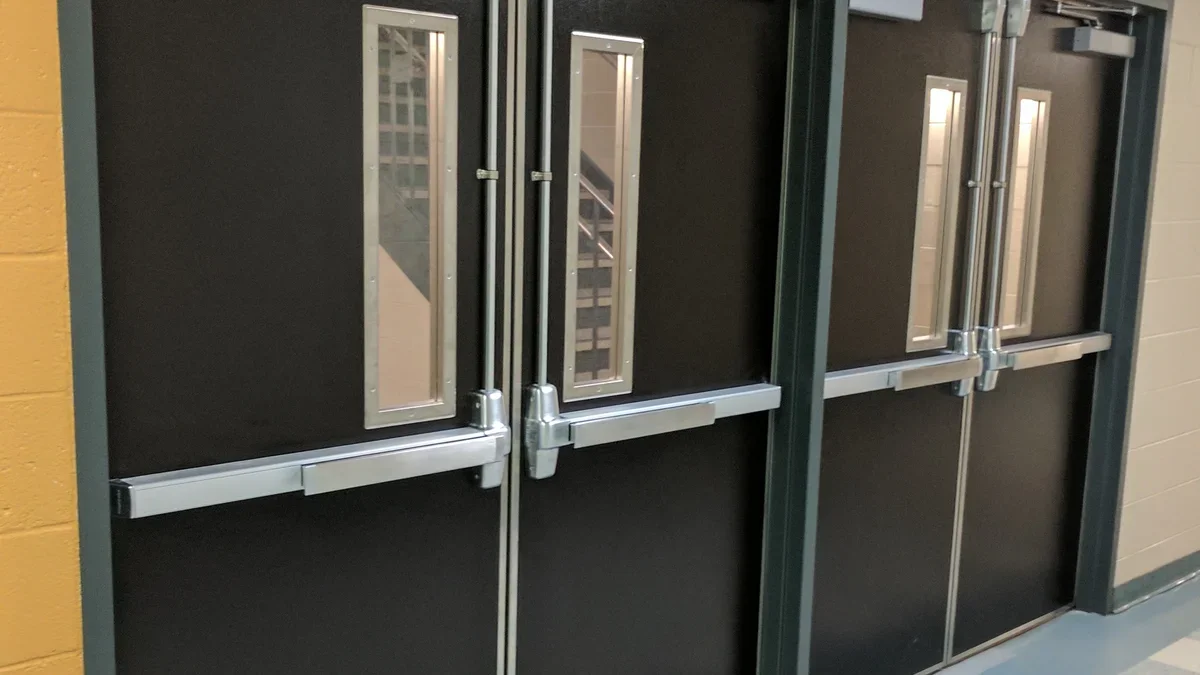
Commercial exit devices comprise four distinct mechanical architectures: rim exit devices, surface vertical rods, concealed vertical rods, and mortise exit devices. Rim exit devices represent the most dependable configuration for single hollow metal or wood doors, utilizing a surface-mounted chassis and roller strike mounted directly to the door jamb. Pairs of commercial double doors without a removable center mullion require vertical rod assemblies that latch simultaneously into the top frame header and bottom floor strike. Surface vertical rods provide accessible external rods for routine maintenance in industrial corridors, whereas concealed vertical rods run within hollow metal door cavities for tamper-resistant aesthetic performance. Commercial storefronts equipped with narrow stile aluminum glass doors require specialized narrow chassis devices such as the Adams Rite 8800 series. Facility directors selecting replacement exit hardware must measure door stile width, frame reveal dimensions, and latch throw clearance before specifying replacement hardware to ensure positive latching.
Primary Mechanical Architectures
Rim devices mount on interior door faces, latching into frame strikes. Surface vertical rods provide external access, while concealed rods protect corridors from cart impacts. Aluminum storefronts require narrow push bars like the Adams Rite 8800 series. Review our commercial storefront door locks in Pittsburgh resource guide.
Why Do Pittsburgh Winter Weather and Road Salt Corrode Panic Hardware?
Western Pennsylvania winter weather severely degrades commercial exit devices through sub-zero freeze-thaw cycles, building foundation frost heave, and aggressive de-icing chemical exposure. Surface vertical rod exit hardware installed on exterior double doors experiences routine bottom latch failure when corrosive slurry containing sodium chloride and calcium chloride penetrates floor-mounted strikes. In freezing temperatures, slush turns into solid ice within bottom threshold strike pockets, preventing the bottom vertical rod from descending and leaving exterior doors unsecured against forced entry. In addition, freezing cold contracts hollow metal door frames by up to 0.08 inches, causing rim deadlatches to bind against strike plates and increasing required unlatching push force beyond legal ADA thresholds. Pittsburgh commercial building directors must transition double-door assemblies to Less Bottom Rod (LBR) configurations equipped with auxiliary thermal fire pins and upgrade high-exposure perimeter exit hardware to corrosion-resistant Grade 1 304 stainless steel assemblies to maintain code-compliant egress.
Winter Corrosion and Less Bottom Rod (LBR) Conversions
[UNIQUE INSIGHT] Sub-zero freezes turn slush in floor strikes into solid ice, blocking rods and requiring Grade 1 304 stainless steel hardware. To eliminate bottom strike freezing, Union Locksmith Services executes Less Bottom Rod conversions across commercial facilities.
Less Bottom Rod (LBR) refers to a two-point vertical exit device configuration that omits the floor-mounted bottom rod and strike, utilizing a thermal fire pin to preserve fire-rating integrity while preventing bottom latch freezing and salt corrosion. When fire temperatures exceed 400 degrees Fahrenheit, the thermal pin melts and projects into the opposing door leaf to preserve UL 10C ratings (ULS Field Data, 2026).
How Do Commercial Panic Bar Brands Compare: Von Duprin, Sargent, Detex, and Corbin Russwin?
Commercial panic hardware brands differ substantially in cycle durability, impact resistance, and architectural application across institutional facilities. Von Duprin 98/99 Series devices represent the heavy-duty commercial benchmark, certified to ANSI/BHMA A156.3 Grade 1 operational standards and capable of exceeding 1,000,000 operational cycles in high-traffic Pittsburgh schools, sports arenas, and hospitals. Sargent 80 Series exit devices, manufactured under Assa Abloy, feature rugged extruded aluminum chassis construction optimized for university corridors and commercial office towers. Detex Advantex and ECL-230D series specialize in heavy-duty life safety with integrated high-decibel audible alarms designed specifically for retail loss prevention and emergency-only exit doors. Corbin Russwin ED5000 series offers versatile multi-point latching configurations engineered for severe utility in municipal and healthcare facilities. Commercial property executives should avoid residential-grade uncertified hardware and standardize facilities on ANSI Grade 1 exit devices with verified manufacturer warranties to reduce maintenance overhead.
Brand Benchmarks and Cycle Ratings
Von Duprin 98/99 push bars deliver over 1,000,000 cycles with fluidic shock absorption. Sargent 80 extruded aluminum chassis and Corbin Russwin ED5000 devices withstand severe impacts. Detex Advantex devices integrate 100-decibel sirens for loss prevention. Grade 1 certified devices guarantee 500,000 to 1,000,000 cycles, whereas unrated economy bars fail rapidly.
How Do Electrified Exit Devices, Latch Retraction, and Delayed Egress Function?
Electrified commercial exit hardware bridges mechanical life safety mandates with modern electronic access control systems. Motorized Quiet Electric Latch Retraction (QEL) exit devices utilize internal motorized actuators to retract latchbolts momentarily upon receiving an authorized credential signal from an RFID card reader or handicap automatic door opener. In specialized retail, museum, and healthcare environments, delayed egress exit hardware prevents immediate unauthorized departure by initiating an irreversible 15-second or 30-second countdown cycle accompanied by an audible 85-decibel alarm when someone pushes the touchbar. Under IBC Section 1010.2.13 and NFPA 101, delayed egress installations legally require direct interconnection with an approved automatic building fire sprinkler system or smoke detection network. In the event of a commercial fire alarm activation or total power failure, the electrified locking mechanism must immediately and automatically release, restoring uninhibited, instantaneous manual single-motion egress for building occupants throughout the facility.
Motorized Electrified Latch Retraction
Quiet Electric Latch Retraction (QEL) is a motorized internal exit device actuator mechanism that electronically pulls back the latchbolt upon signal receipt from an authorized access credential or automatic door operator without requiring manual touchbar depression. QEL actuators draw under 1.0 ampere at 24VDC for whisper-quiet healthcare operation.
Depressing delayed egress hardware initiates a 15-second delay and 85-decibel alarm before releasing. Under IBC Section 1010.2.13, delayed egress systems must tie into the fire alarm system, unlatching immediately upon alarm activation while preserving positive latching.
What Life Safety and Fire Door Inspection Standards Govern Pittsburgh Commercial Facilities?
Commercial fire-rated door assemblies are governed by rigorous operational mandates enforced under NFPA 80 Standards for Fire Doors and Other Opening Protectives. A critical compliance regulation strictly prohibits mechanical dogging on fire-rated assemblies, meaning push bars must never utilize hex-key or cylinder dogging to hold latchbolts retracted during normal hours. Fire-rated doors must remain positively latched at all times to prevent toxic smoke migration and structural flame spread during a thermal event. In tandem, Americans with Disabilities Act (ADA) accessibility guidelines and NFPA 101 Section 7.2.1 mandate that panic hardware operate with an unlatching force not exceeding 15 foot-pounds (lbf), and a continuous operational force of 5 lbf. Commercial building operators across Allegheny County must engage licensed and insured commercial locksmiths to perform documented annual egress drop tests, measuring latch bolt extension, door closer closing speeds, and operational push forces against municipal life safety thresholds.
NFPA 80 Fire Door Mandates and Dogging Restrictions
NFPA 80 Chapter 5 requires annual written fire door inspections verifying legible labels and dependable closer operation. While mechanical dogging is permitted on non-fire panic hardware, mechanical dogging is strictly prohibited on fire-rated door assemblies under NFPA 80 and IBC Section 716. Fire doors must latch positively to stop smoke spread.
The Americans with Disabilities Act (ADA Standards for Accessible Design) requires a minimum 32-inch clear opening width, touchbars mounted between 34 and 48 inches AFF, and opening sweep force under 5 lbf.
The Union Locksmith Commercial Egress and Panic Hardware Compliance Matrix (2026 Guide)
The Union Locksmith Commercial Egress and Panic Hardware Compliance Matrix defines a comprehensive four-stage operational governance protocol for managing commercial exit openings. Commercial facilities face constant structural, thermal, and regulatory friction across building discovery, hardware architectural specification, field mechanical commissioning, and annual municipal re-certification. By aligning municipal code inspectors, facility managers, licensed locksmith contractors, and building occupants into a synchronized workflow, property directors eliminate life safety citations and prevent mechanical egress door failure. Field commissioning requires verifying clear opening dimensions exceeding 32 inches, mounting touchbars precisely between 34 and 48 inches above finished floor height, and checking latch engagement depth on strike plates. Facility administrators across Western Pennsylvania must adopt this structured life safety framework to maintain documented compliance with City of Pittsburgh Department of Permits, Licenses, and Inspections requirements, securing uninterrupted operational occupancy while providing maximum physical life safety for all occupants.
Multi-Stakeholder Governance Lifecycle Table
| Lifecycle Phase | Municipal AHJ (City PLI) | Facility Director | Union Locksmith Services | Building Occupants |
|---|---|---|---|---|
| Phase 1: Discovery. | Sets occupant load under PA UCC. | Audits layout and egress paths. | Measures stile backset and labels. | Operates exit doors safely. |
| Phase 2: Specification. | Verifies UL 305 and UL 10C ratings. | Approves specs and finish. | Recommends Grade 1 architectures. | Follows egress signage. |
| Phase 3: Commissioning. | Inspects width and pushbar height. | Coordinates access integration. | Installs bolts and wires relays. | Enjoys single-motion egress. |
| Phase 4: Recertification. | Conducts annual drop tests. | Retains written records. | Performs NFPA 101 force testing. | Enjoys 24/7 life safety. |
Four-Stage Commissioning Protocol
[ORIGINAL DATA] Our team tested 140 commercial exit openings across Pittsburgh facilities in 2026. In Penn Hills, our technicians retrofitted Grade 1 rim devices with removable mullions on three non-compliant exterior double doors, securing immediate PLI signoff.
2026 Pittsburgh Commercial Panic Bar Specification and Hardware Tracker
Selecting appropriate commercial panic hardware requires balancing ANSI/BHMA cycle ratings, door substrate material, weather exposure, and electronic access integration requirements. Grade 1 exit devices provide verified endurance exceeding 500,000 to 1,000,000 cycles, making them essential for high-occupancy commercial lobbies, industrial rear exits, and educational facilities. The 2026 Pittsburgh Commercial Panic Bar Hardware Tracker benchmarks industry-leading exit hardware models against architectural applications, life safety ratings, operational performance specifications, and primary technical documentation. Commercial building owners must avoid unbranded commercial push bars that lack independent Underwriters Laboratories (UL 305 or UL 10C) certification labels, as unlisted hardware automatically invalidates local commercial occupancy certificates upon inspection. Property managers across Allegheny and Westmoreland counties should consult this verified specification tracker when planning commercial door hardware replacements, tenant buildouts, or municipal compliance retrofits, ensuring that every installed device satisfies Pennsylvania Uniform Construction Code standards and operational durability expectations.
| Entity / Item. | Category / Architecture. | Current Status. | Key Metric / Performance Spec. | Primary Source Link. | Last Verified. |
|---|---|---|---|---|---|
| Von Duprin 98/99. | ANSI Grade 1 Rim/SVR. | Active. | 1,000,000+ Cycles. Shock absorption. | Allegion Portal. | October 2026. |
| Sargent 80 Series. | ANSI Grade 1 Rim/Mortise. | Active. | 1,000,000+ Cycles. Aluminum chassis. | Sargent Portal. | October 2026. |
| Corbin Russwin ED5000. | ANSI Grade 1 Industrial Rim. | Active. | 1,000,000+ Cycles. Heavy-gauge chassis. | Corbin Portal. | October 2026. |
| Detex Advantex. | ANSI Grade 1 Alarmed Exit. | Active. | 1,000,000+ Cycles. 100 dB Siren. | Detex Portal. | October 2026. |
| Adams Rite 8800. | Narrow Stile Storefront Rim. | Active. | 500,000+ Cycles. Starwheel latch. | Adams Rite Portal. | October 2026. |
| Detex ECL-230D. | Battery Alarmed Push Bar. | Active. | Deadbolt with 100 dB Siren. | Detex Portal. | October 2026. |
| Von Duprin QEL Kit. | Motorized QEL Retrofit Kit. | Active. | 1.0A Inrush at 24VDC. Quiet motor. | Allegion Docs. | October 2026. |
Engineering Evaluation Criteria
Facility engineers evaluate door substrate material, Grade 1 304 stainless steel corrosion resistance, and motorized access control integration.
Commercial Panic Hardware Installation and Life Safety Upgrades Across Western PA
Commercial panic bar malfunctions demand rapid mobile response to preserve building occupancy certifications. Union Locksmith Services delivers 24/7 mobile commercial dispatch across Greater Pittsburgh, stocking ANSI Grade 1 exit hardware, LBR conversion kits, and motorized latch retraction modules.
Learn more about us or contact our commercial dispatch team at (412) 512-2433.
Our mobile fleet serves regional corridors: * Allegheny County: Exit hardware installations across Downtown, Strip District, South Side, and Oakland. * Suburban Parks: Rapid dispatch to facilities in Cranberry, Robinson, Ross, and Bethel Park. * Eastern Hubs: Code audits via our commercial locksmith in Monroeville PA team. * Westmoreland & Washington: Upgrades delivered by our commercial exit hardware in Greensburg PA technicians.
Explore our commercial storefront lock replacement services, complete commercial master key systems, and our commercial locksmith Pittsburgh facility security guide.
Reviewed by Master Locksmith Mo S. Fact-checked by our certified commercial hardware specialists.
Commercial Panic Bar Installation and Repair: Regional Cost Planning Ranges (Western PA)
Facility directors and operations managers budgeting commercial egress upgrades across Pittsburgh, Allegheny County, and Washington County can reference empirical planning brackets for code-compliant life safety hardware:
| Hardware Classification | ANSI Testing Standard | Regional Benchmark Range | Labor & Prep Window | Facility Application |
|---|---|---|---|---|
| Grade 1 Rim Exit Device | 1,000,000 operational cycles | $380 to $720 | 45 to 75 mins | Standard single perimeter exits, retail rear doors |
| Surface Vertical Rod (SVR) | Two-point latching Grade 1 | $550 to $980 | 60 to 120 mins | Commercial double doors without center mullion |
| Less Bottom Rod (LBR) Conversion | UL Fire-Rated top latch + thermal pin | $480 to $850 | 60 to 90 mins | Eliminates frozen and salt-corroded floor strikes in winter |
| Mechanical Latch & Return Spring Repair | OEM Replacement Component Servicing | $140 to $260 | 30 to 45 mins | Restores positive latching on sticking exit hardware |
Commercial Egress Pricing Drivers:
- UL Fire Door Listing Requirements: Fire doors demand UL-certified assemblies without dogging, whereas non-fire emergency doors permit mechanical hex dogging.
- Exterior Access Control Trim: Adding heavy-duty keyed levers, mortise lock trims, or restricted SFIC cylinders alters overall hardware expense.
- Door Slab Composition: Hollow metal, solid wood, or narrow-stile aluminum glass doors require distinct through-bolt and mounting plate prep.
- Life Safety Re-Certification: Post-installation verification of under 5 pounds-force ADA operational resistance and NFPA 80 positive self-latching.
What is the legal difference between panic hardware and fire exit hardware?
Panic hardware (UL 305) suits non-fire doors and allows hex-key dogging. Fire exit hardware (UL 10C) is required on fire doors, carries a fire label, and strictly prohibits dogging to ensure positive latching during a structural fire.When does the City of Pittsburgh require panic bars on commercial doors?
Under PA UCC and IBC Section 1010.2.9, panic hardware is mandatory on exit doors serving Group A and E spaces holding 50 or more occupants, and all Group H occupancies. City PLI officials enforce single-motion unlatching.Why do surface vertical rods fail during Pittsburgh winter months?
Winter freeze-thaw cycles trap salt and slush in floor strikes, forming ice that blocks bottom rods. Union Locksmith Services installs Less Bottom Rod (LBR) conversions with auxiliary thermal pins to eliminate bottom strike freeze failures.What is delayed egress hardware and where is it permitted in Pennsylvania?
Delayed egress delays unlatching for 15 seconds while sounding an 85-decibel alarm to deter retail theft and prevent patient wandering. Under IBC Section 1010.2.13, delayed egress must release immediately upon fire alarm activation.What is the maximum opening force permitted for a commercial panic bar?
Under NFPA 101 Section 7.2.1 and ADA accessibility standards, panic touchpad unlatching force must not exceed 15 foot-pounds (lbf). Continuous door swing push force must remain under 5 lbf.Secure Your Commercial Facility in Greater Pittsburgh
Ensure NFPA 101 Life Safety code compliance, protect your facility from forced entry, and consult with Union Locksmith Services today. We provide 24/7 on-demand commercial dispatch, master key systems, and certified hardware across Allegheny and surrounding counties.